Dogs of Havoc: Developing a mass combat ruleset for A5E
In 500 BC, Sun Tzu wrote a book called The Art of War, and certainly there is an esoteric skill required to develop and execute strategies for a successful military campaign. But seeing and analyzing war from a philosophical perspective is a far cry from experiencing it firsthand as a soldier on the frontline, and there is little beauty to be found in the horror that is war.
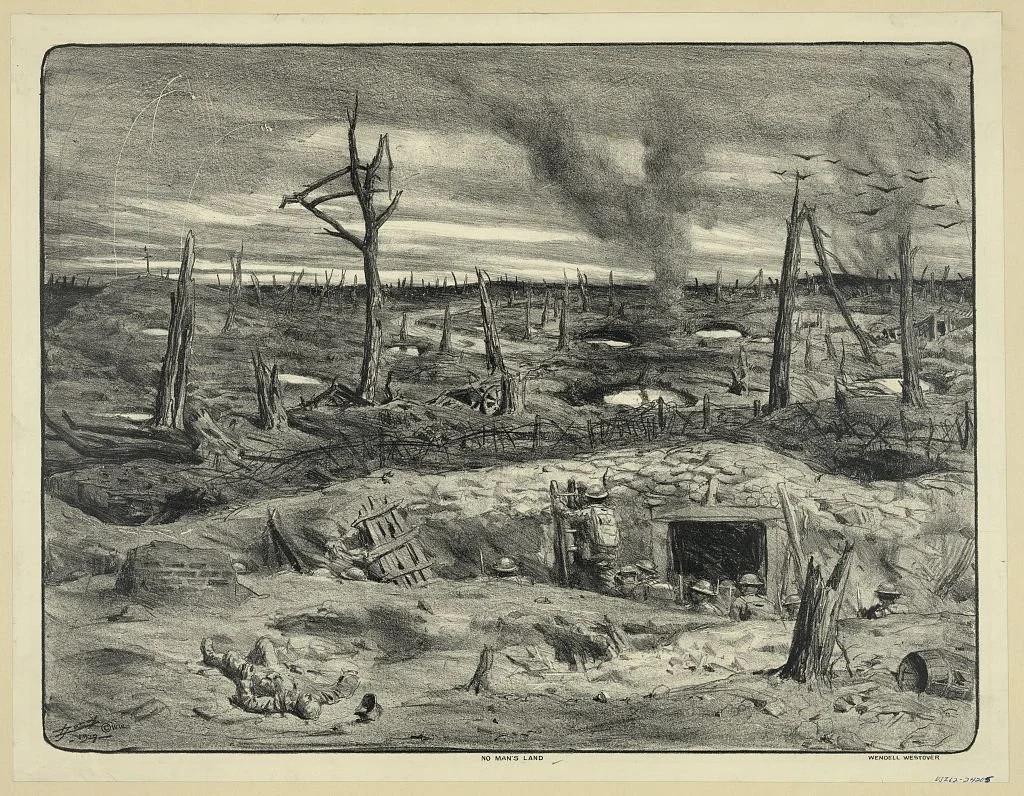
No Man's Land by Lucien Jonas, 1927
Library of Congress
…there is little beauty to be found in the horror that is war
Yet there are stories of courage and camaraderie, of brilliant maneuvering and cunning tactics, of heroic deeds and making the ultimate sacrifice. And these stories exist, not because of the ugliness of wartime violence, but in spite of and in stark contrast to it. And so in the treatment of war as a tabletop roleplaying game mechanic, we must be careful not to celebrate it as a grand stage upon which to perform acts of greatness, but rather recognize it as a grim nightmare within which to shine as a beacon of hope and from which to awaken sober and forever changed. Not all art is beautiful, but the best art evokes a visceral emotion that profoundly affects its audience and transforms their individual perspectives in a meaningful and often personal way.
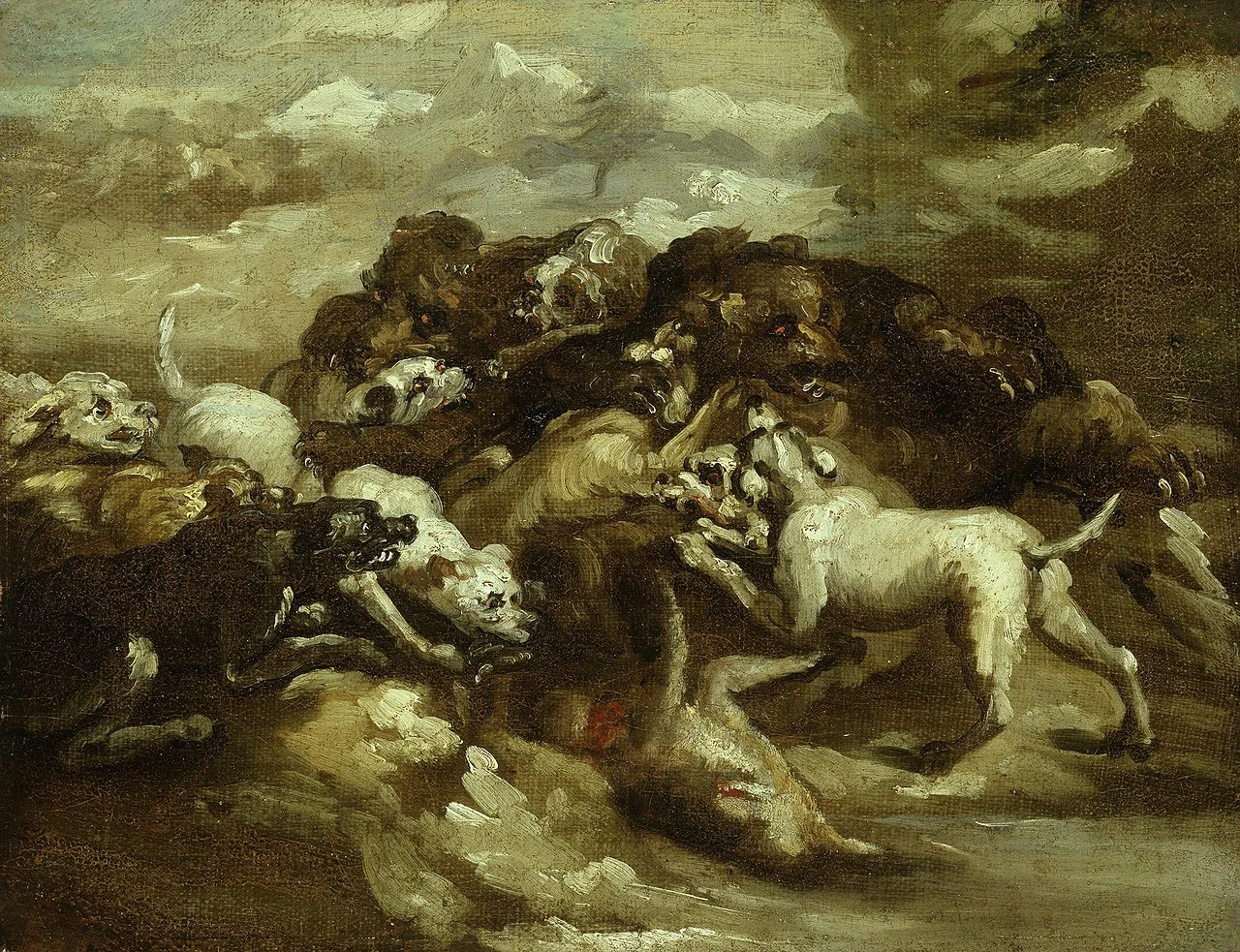
Dogs Fighting Bears by Théodore Géricault
(CC0 Public Domain)
Not all art is beautiful, but the best art evokes a visceral emotion that profoundly affects its audience…in a meaningful and often personal way.
A while back I proposed to develop a set of rules for mass combat in A5E. I had a concept and a vision and a 2,000 word budget, and with that I dove in and went to work. Mechanics and math and fluff text poured out of me for weeks, and 4,000 words later I was over budget, past my deadline, and no closer to completing a ruleset I was happy with than when I started.
I did more research. I bit the bullet and started looking at other designers’ concepts and implementations. I revised and rewrote and trimmed and edited down to 3,000 words. And it was still a train wreck. Although the math seemed to jive for the most part, the mechanics were clunky and almost completely divorced from the core rules, encounter preparation was incredibly cumbersome, and most of the fluff had been tossed out in a futile attempt to save on words.
I began to question whether it was a skill issue on my part, an impossible wordcount limit, or a fundamental incongruity with trying to reunite a TTRPG with the wargaming roots from which it had branched off so long ago.
Perhaps in the end it was a bit of each. And yet…here I am at it again. A little older and (arguably) a little wiser.
Quick sidebar regarding the title of this article. Many are familiar with or have at least heard in passing the quote from Shakespeare’s Julius Caesar, "Cry 'Havoc!', and let slip the dogs of war." The phrase has become synonymous with a sentiment to sow chaos and general mayhem or the threat of it at least. But today I learned “Havoc!” was a military command (like “Halt!” or “Advance!”) and was used as the signal to permit pillaging and plundering (with the king’s consent and authority of course). And with regard to the dogs of war, huge (250+ lb.) mastiffs were actually deployed into battle to disrupt cavalry, maul enemy soldiers, and hunt down and eviscerate hidden ambushers. Understanding this context serves as a chilling reminder of the brutality of war and the nature of those that fought and commanded in them.
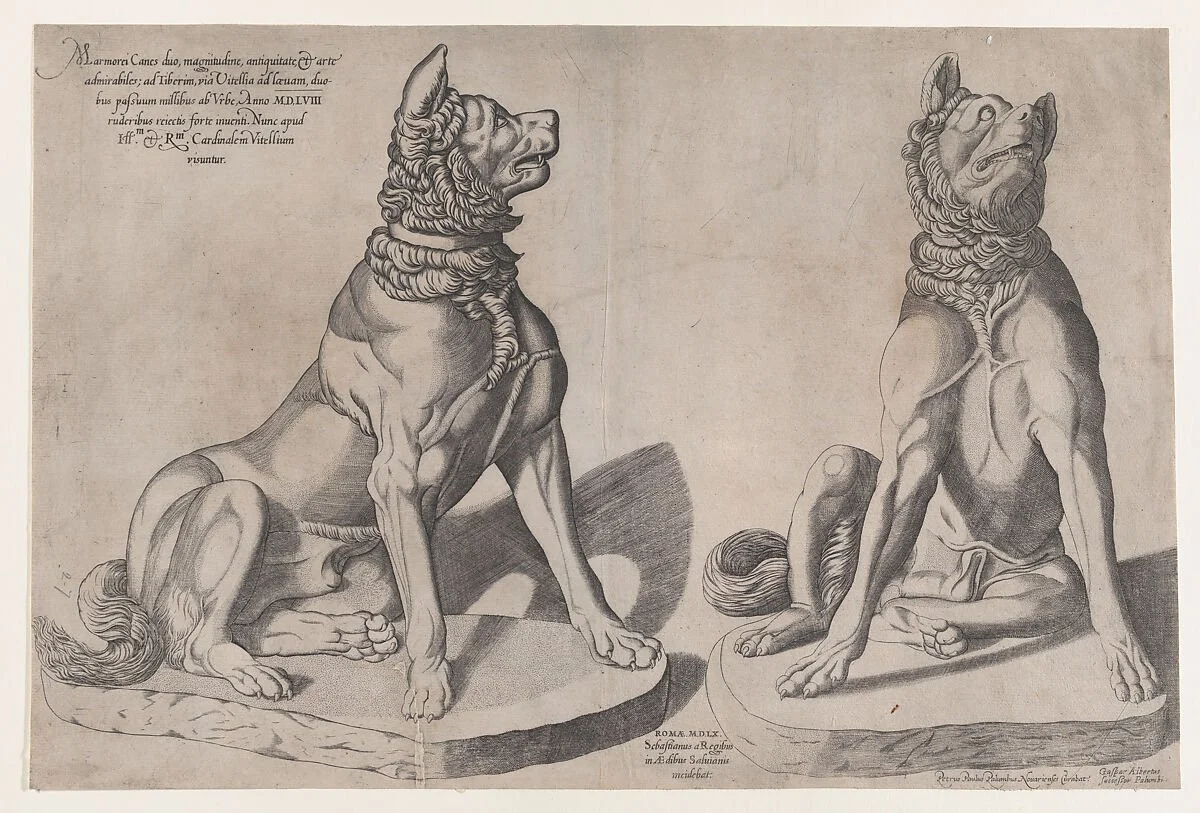
Two Dogs, from "Speculum Romanae Magnificentiae"
(CC0 Public Domain)
…mastiffs were actually deployed into battle to disrupt cavalry, maul enemy soldiers, and hunt down and eviscerate hidden ambushers
But what role do the harsh realities of war have to play in my make believe world of dwarves and elves? Well a few things I suppose. For one, if we consider the Tolkien influence on the origins of D&D, there are several wars and battles that have quite an impact on the stories of the hobbit heroes. To find a way to do them justice, or at least pay them homage, in the game seems appropriate. Second, what is roleplay and storytelling without drama or drama without conflict? And what is war but Conflict (with a capital “C”)? The trick is getting the balance just right where we feel the weighty consequences of war and see the terrible face of humanity at its worst reflected in our experience at the table without falling victim to the despair and meaninglessness of all the pain and suffering wrought by war. We must face an evil whose potential lurks within each of us yet come out of it with our souls intact and victorious over our collective historical human sins. For art imitates life (and yes there is art in our gameplay), but life imitates art to a degree as well.
Deep thoughts, dark thoughts, for a blog that’s supposedly about a game we are meant to enjoy. Are we having fun yet? Are you not entertained?
Blood. Death. Killing. For what? A king? A crown? The survival of a way of life? At the expense of another? At least in fantasy we might imagine there is true good and true evil and it is knowable because evil embraces death while good embraces life. And yet, to preserve and protect life must one take life from those who align themselves with that which threatens to destroy all? Is it justified? Is it just? Is it good? In a game of roleplay, as in life, we may not find all the answers we seek, but we still need to ask the questions, because the journey of discovering what truths do exist is worth the effort.
Roleplaying games are as much about the journey as the destination. As much about the achievement as the steps it took to attain it. The real treasure was all the gold we found at the end. Er, I mean all the friends we made along the way. But why not both? Why not enjoy the hard won magical loot and overflowing treasure chests and the defeating of the BBEG? And yes, the friends. Of course, the friends. No victory is more empty than one where you have no one to share it with.
And now I really have gone too far down a rabbit hole and need to return somehow to my point. Which is an elegant ruleset for war and mass combat that fits within the framework of an established tabletop roleplaying game but also feels different and alive and dramatic and real (but not too real). One that is rewarding, not just at the end with a victory, but all along the way as well, or even in (gasp!) defeat. Where each skirmish might be your last but feels like your first. Where the stakes are high and the odds are stacked against but never impossible (not unlike this task I’ve set before me).
In such a situation as this, it’s easy to become overwhelmed, and the urge to turn tail and run rises up in my gut. But I’ve been here before, I tell myself. I can do this. I will do this, and this, this is the feeling I want to capture. This moment of doubt in the midst of chaos and fear. This choice to flee like the weak, pathetic mortal I know myself to be vs. the choice to stay and fight and wrestle down my insecurities and just do what needs to be done.
Can a game ruleset even do this? Evoke a visceral, near-vomitous response? In the end, rules are just words, and yes, words can do this thing. Life and death are in the power of the tongue. And this is just make believe life and death. This is just fantasy war. This is just a game. And games I can do.
Between my initial draft and edits plus a wholesale reworked second attempt, I’ve already written upwards of 8,000 words of rules and ideas, notes and calculations. It’s a matter now of discernment and design: curating and refining and shaping and developing and reshaping until it’s just right.
Based on where I’m currently at, I’m thinking 3,500 words should be enough to convey the core of the ruleset with 1,500 words for some battlefield dressing text and tables, and maybe another 1,000 for a few examples of play. If things go the way I hope, that 6k words of content will even include a combat tradition.
That’s 3 times the original word budget, but IMO, trying to tackle it in too much less would start cutting into clarity of the rules as intended and diminish the overall quality of the design. Still, that’s only an estimate at this point. The final solution may end up flexing up or down in total word count. I still need to 1) finish the draft, 2) edit it, 3) playtest it, 4) revise after getting feedback, and 5) polish it up and add some art to get it publish-ready.
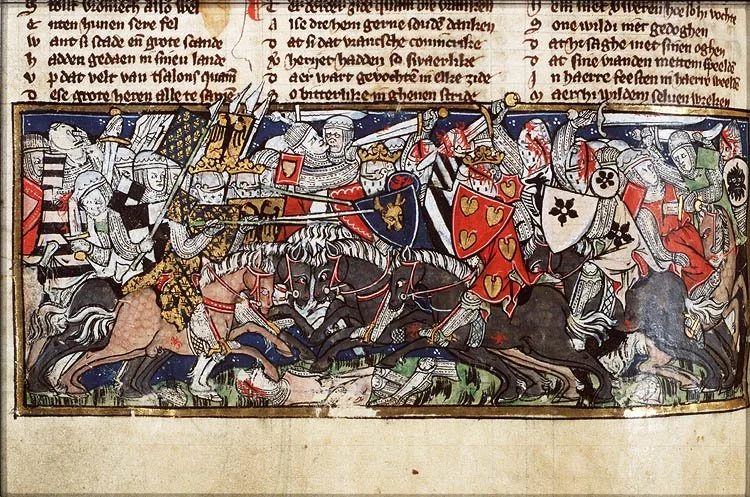
Battle in the Catalan Plain between Attila, Aetius, Meroveus and Theodoric I
National Library of the Netherlands (CC0 Public Domain)
On that note, I’m calling this post done. Now to get me my mass combat rules done! Oh, and I haven’t forgotten about the Spiritualist (now Shamanist!) or the instructional course on designing and publishing a full Character Class! Stuff is in the works; I just gotta start churning it out :)